Role Prompting and Prompt Length: What Actually Helps
Does telling AI to act as an expert help? How long should a prompt be, and how many questions can you ask at once? A practical guide to what works.

By Maximus Mediascape
TLDR
Discover 10 AI prompting techniques for better responses. Learn how to write clearer prompts and get more useful results from AI for your business.
Ask AI to summarise
AI tools can help business owners with everything from writing emails and researching ideas to planning projects and analysing information. But if you have ever asked an AI tool to do something for your business and received a vague, generic or unhelpful answer, the problem may not be the tool itself.
It may be the prompt.
The instructions you give an AI tool influence how it understands your task and what kind of response it produces. Learning a few AI prompting techniques for better responses can help you get more useful results without making every prompt unnecessarily complicated.
Here are 10 techniques business owners can use when working with AI.
AI prompting techniques are different ways of structuring instructions so an AI tool has a clearer understanding of what you want it to do.
A simple request such as:
Write a social media post about our new service.
leaves plenty of room for interpretation.
A more detailed prompt could be:
Write a LinkedIn post for UK small business owners introducing our new bookkeeping service. Focus on how it can save business owners time, use a professional but approachable tone, and finish with a simple call to action.
The second prompt gives AI more information about the task, audience, tone and desired outcome.
If you are still getting familiar with the basics, understanding how to write effective AI prompts can help you build a stronger foundation before experimenting with more specific techniques.
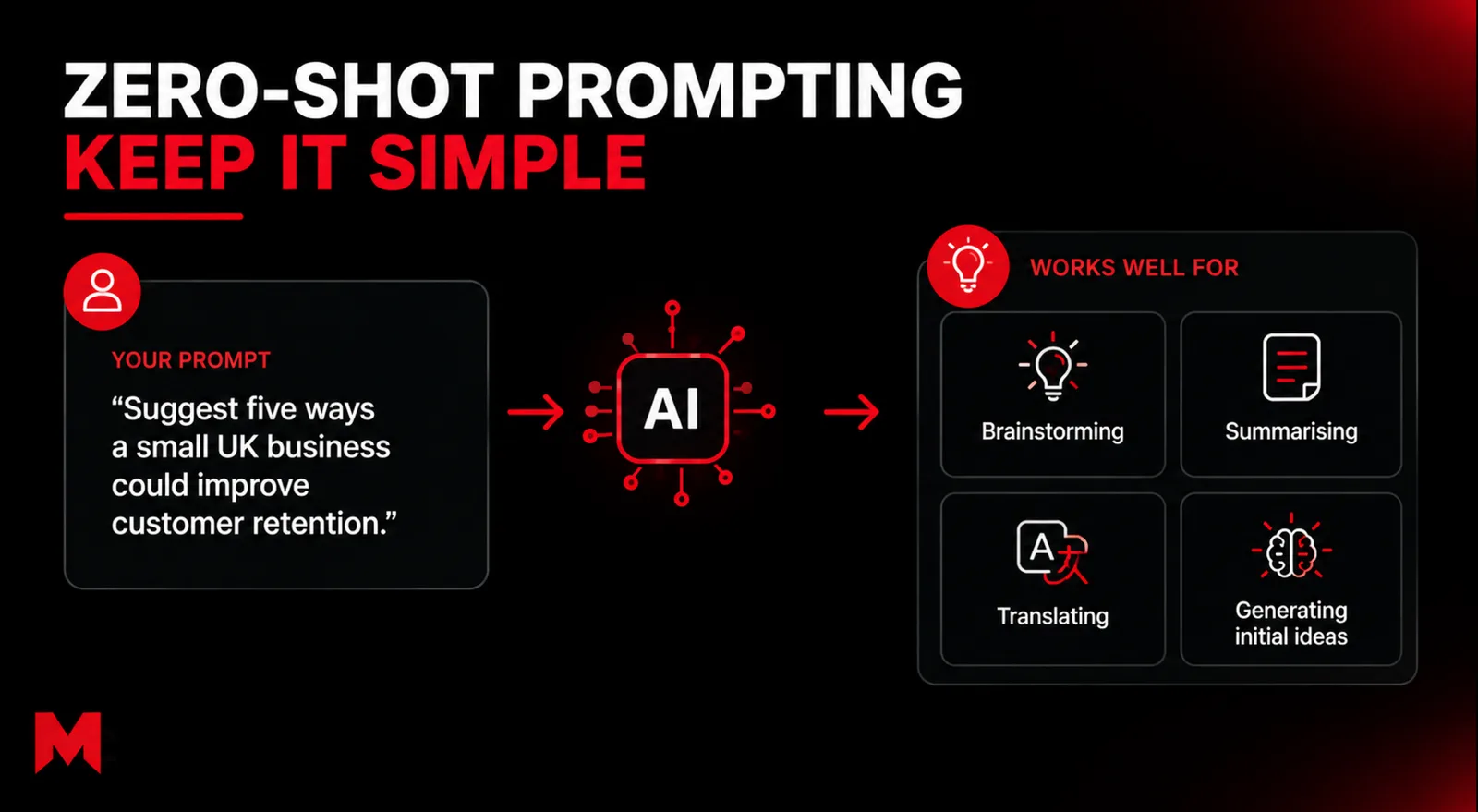
Zero-shot prompting means asking AI to complete a task without providing examples of the result you want.
For example:
Suggest five ways a small UK business could improve customer retention.
You have given the AI a clear task, but no examples to follow.
This approach can work well for straightforward tasks such as brainstorming, summarising, translating or generating initial ideas.
For business owners, zero-shot prompting is often the simplest place to start. If the result is useful, you may not need to make the prompt more complicated.
Few-shot prompting involves giving AI one or more examples before asking it to complete a similar task.
For example:
Here are two examples of our customer emails. Study their tone and structure, then write a new email announcing a change to our opening hours.
The examples give the AI a clearer idea of what you mean by a particular tone, format or style.
This can be particularly useful when consistency matters. A business could provide examples of customer emails, product descriptions, reports or social media posts and ask AI to use them as a guide.
The goal is not to provide as many examples as possible. The examples should be relevant and representative of the result you want.
Role prompting involves giving AI a particular role or perspective before asking it to complete a task.
For example:
Act as a customer service manager for a UK e-commerce business. Draft a response to a customer whose order has been delayed.
The role gives the AI additional context about the perspective it should take.
A business owner could use this technique for tasks involving customer service, recruitment, sales, operations, research or internal communications.
It is important to remember that assigning a role does not turn the AI into a real-world expert. It simply helps provide direction for the response.
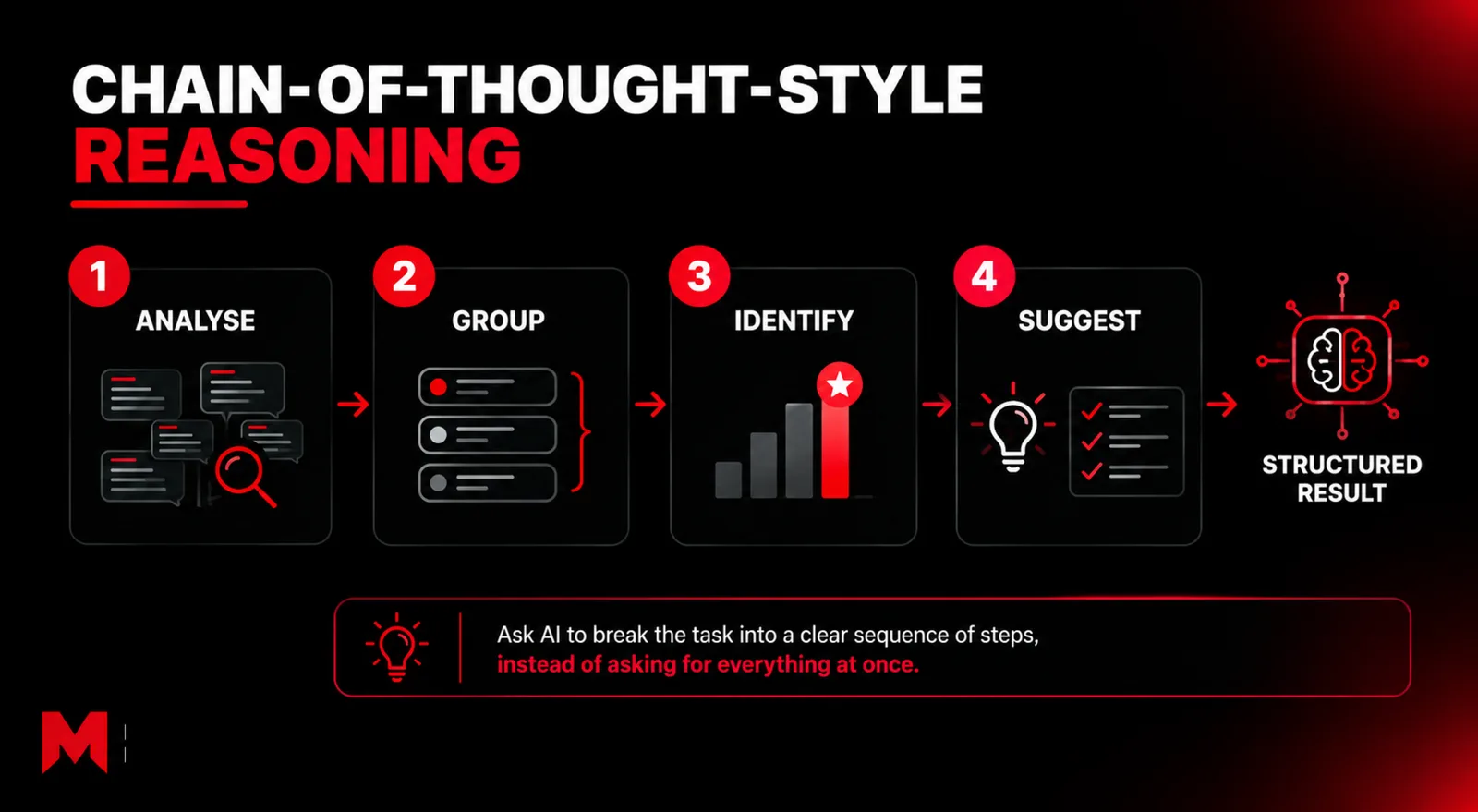
Some tasks are more complicated than simply asking for an answer. They involve several stages of analysis or decision-making.
For these situations, you can ask AI to approach the task in a structured sequence.
For example:
Analyse these customer complaints. First group them into common themes, then identify the most frequent issues, and finally suggest practical ways we could address them.
This approach breaks a complex problem into stages rather than asking for everything at once.
For business owners, this can be useful when working through research, customer feedback, planning or other tasks that involve several connected steps.
The focus should be on asking AI to structure the task clearly, rather than assuming that an AI-generated explanation is automatically correct. Important conclusions should still be reviewed.
Structured prompting means organising your instructions so that different requirements are clearly separated.
For example:
Business: UK-based online furniture retailer
Audience: Homeowners aged 30-55
Task: Create five blog ideas
Tone: Professional and approachable
Output: Table with topic, search intent and suggested title
This gives AI a clear set of instructions instead of placing everything into one long paragraph.
It can be particularly helpful for recurring business tasks where you want consistent outputs from one prompt to the next.
Contextual prompting focuses on giving AI the background information it needs to understand your request properly.
AI does not automatically know your business, customers, services, competitors or objectives.
Compare:
Give me some ideas for promoting my business.
with:
We are a small UK-based accountancy firm serving freelancers and contractors. We want to increase enquiries from this audience without relying on discounts. Suggest five practical marketing ideas.
The second prompt provides considerably more context.
This is one of the most useful AI prompting techniques for better responses because business tasks often depend heavily on information that is specific to the company.
Iterative prompting means improving your instructions based on the response you receive.
You do not always need to create the perfect prompt on the first attempt.
For example, you could start with:
Give me five ideas for improving customer retention.
Then refine the result:
Focus specifically on ideas that do not require discounts.
Then:
Make the ideas suitable for a small business with a limited team.
Then:
Rank the ideas by how easy they would be to implement.
Each instruction builds on the previous response.
This approach makes AI more useful for real business work because you can gradually guide the output towards what you actually need.
Prompt decomposition involves breaking a large or complicated task into smaller tasks.
Instead of asking:
Research our competitors, analyse their marketing, identify gaps and create a strategy for us.
you could divide the process into stages:
This makes a complex task easier to manage and gives you an opportunity to review the information before moving to the next stage.
For business owners, this can be useful when using AI for research, planning, analysis and larger projects.
Output constraints tell AI exactly how you want the final response presented.
You might specify:
For example:
Write a 500-word article for UK business owners. Use short paragraphs, three H2 headings and no more than five bullet points. Keep the language straightforward and avoid unnecessary technical terms.
Without those constraints, AI has to decide what the final output should look like.
Giving it those boundaries can make the response much closer to something you can actually use.
Once AI has produced an answer, you can ask it to review the result against specific requirements.
For example:
Check the response against the original requirements. Identify anything that is missing, unclear or unsupported, then provide a revised version.
You can also give it a checklist:
Before providing the final answer, check that all five requested points have been covered, the response is under 500 words and the tone is suitable for UK business owners.
This can help identify omissions and improve consistency.
However, self-critique does not replace human judgement. AI can still make mistakes when reviewing its own output, so important facts, figures and business decisions should be checked independently.
You do not need to choose just one technique for every prompt.
In practice, several techniques can be combined.
For example, a business owner planning a customer email could use:
**Role prompting:**Act as a customer service manager.
**Contextual prompting:**We are a UK-based online furniture business and a customer’s delivery has been delayed.
**Output constraints:**Write a concise email of around 150 words.
**Iterative prompting:**Make the response warmer while keeping it professional.
The result is a much more directed request than simply asking AI to “write a customer email”.
The most useful AI prompting techniques for better responses will depend on the task you are trying to complete.
You do not need to memorise dozens of prompting formulas.
For many business tasks, a useful starting structure is:
Role + Context + Task + Audience + Constraints + Output
For example:
Role: Act as a customer service manager.
Context: We run a UK-based online furniture business.
Task: Draft a response to a customer whose delivery has been delayed.
Audience: A frustrated customer.
Constraints: Be polite and concise. Do not promise a delivery date we cannot confirm.
Output: One email of around 150 words.
Not every prompt needs all six elements. A simple request may only need a clear task, while a more complicated piece of work may benefit from additional context and structure.
If you want to explore the fundamentals in more detail, our guide to building a really good AI prompt looks at how to give AI clearer instructions and get closer to the result you actually want.
These AI prompting techniques for better responses can be applied to many everyday business tasks, including content creation, customer communications, research, planning, brainstorming and internal documentation.
For businesses that want to move beyond using AI manually, the next step may be exploring how AI can become part of wider business processes. Maximus Mediascape also provides AI, automation and chatbot solutions covering areas such as customer support, lead qualification, CRM integration and workflow automation.
The goal is not simply to use AI more often. It is to give it better direction and use the resulting information thoughtfully.
When you understand how different prompting techniques work, AI becomes a more practical tool for tackling everyday business tasks.
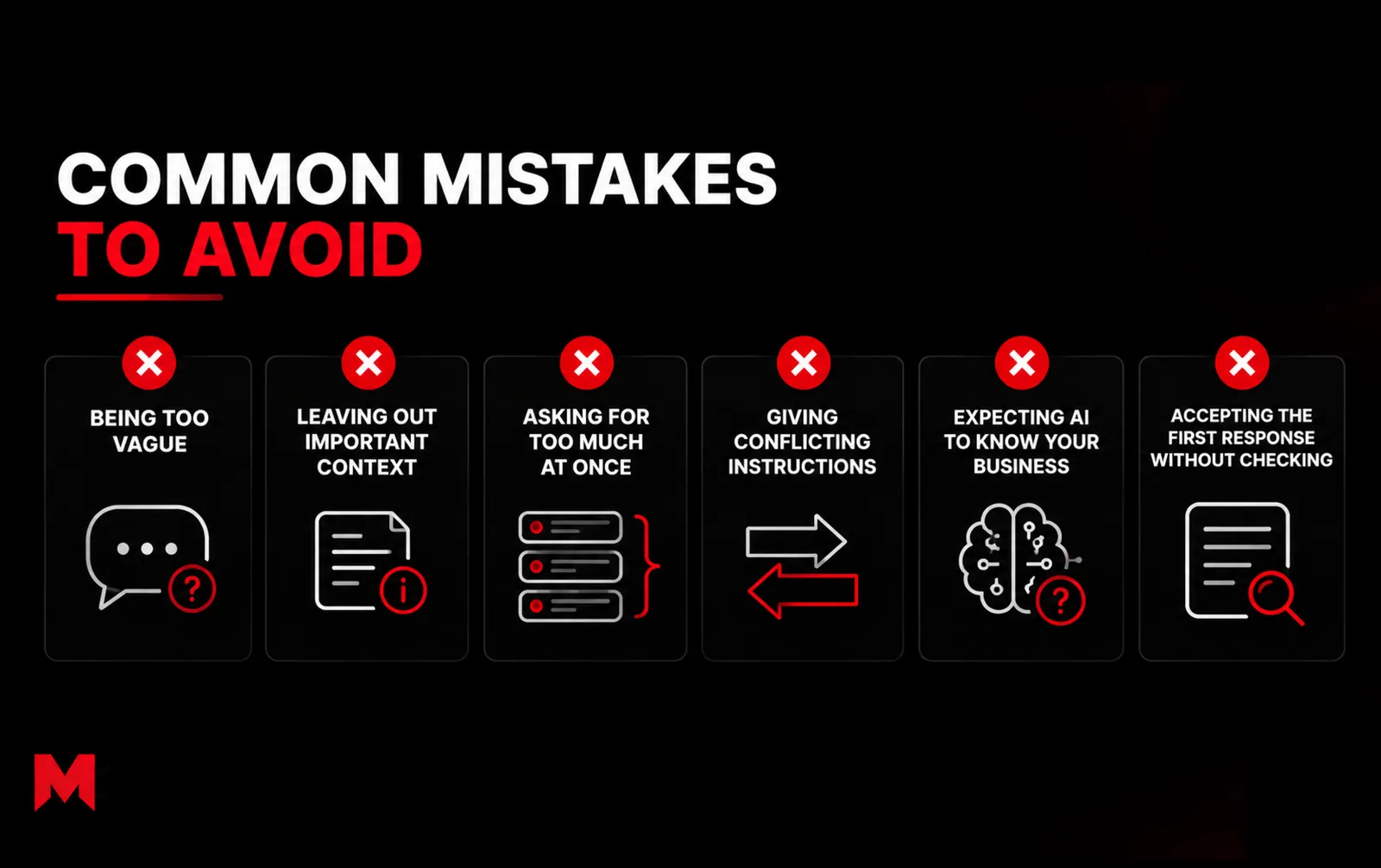
Related guides: What Is an AI Prompt? A Beginner’s Guide, Role Prompting and Prompt Length: What Actually Helps, How to Improve an AI Response When the First Answer Misses, 10 Common AI Prompting Mistakes and How to Fix Them.
AI prompting techniques are methods for structuring instructions so AI tools have a clearer understanding of what you want them to do. Techniques such as zero-shot prompting, few-shot prompting, role prompting and structured prompting can help make AI responses more relevant and useful.
There is no single technique that works best for every task. Beginners can start with clear, specific prompts that explain the task, provide relevant context and describe the desired output. Zero-shot prompting is often a simple starting point for straightforward requests.
Give AI enough information to understand the task. Include relevant context, your target audience, specific requirements and the format you want the response in. You can then use iterative prompting to refine the result if the first response is not quite right.
Zero-shot prompting asks AI to complete a task without providing examples. Few-shot prompting provides one or more examples to show AI the type of response, tone or format you want. Few-shot prompting can be useful when consistency or a specific style is important.
Role prompting can be useful when you want AI to approach a task from a particular perspective. For example, asking it to act as a customer service manager can help frame a customer communication appropriately. However, assigning a role does not make AI a qualified expert, so important information should still be checked.
AI does not automatically know the details of your business, customers or objectives. Adding relevant context gives it information it can use when generating a response. For example, explaining your industry, target audience, location and specific business goal can make a response more relevant than a general request.
No. Better prompts can give AI clearer direction, but they do not guarantee an accurate or useful result. The quality of the response can also depend on the AI model, the information provided, the complexity of the task and how the output is reviewed and refined.
Want this handled for you every month? See our Care and Growth plans, start with the Starter plan, or see all our services. Curious who we are? Read about us and how we work.
Built to be quoted by AI. This page ships with the same structured data we set up for clients.
Does telling AI to act as an expert help? How long should a prompt be, and how many questions can you ask at once? A practical guide to what works.

Ten common AI prompting mistakes, why each one gives weak answers, and the fix. Covers vague asks, missing context, conflicting rules and unchecked facts.

Ready-to-adapt AI prompt examples for business, from customer replies to marketing copy and meeting notes, with tips on why each one works.
The first AI answer is rarely the final one. Learn how to tailor an AI response with follow-up prompts, fix common misses and stop them happening again.
A practical checklist for writing effective AI prompts for real business tasks, with before-and-after examples you can follow.

New to AI? Learn what an AI prompt is, what makes a good one and the simple habits that help beginners get clearer, more useful answers.
Type what you want to be found for. We'll come back with a real plan, not a sales pitch.