Ads in ChatGPT: What This Means for Your Marketing Strategy
Ads in ChatGPT are here. Discover what businesses need to know about OpenAI's advertising rollout and how to adapt your marketing strategy.
By Maximus Mediascape
TLDR
Testing ads in ChatGPT: discover how the OpenAI pilot works and the best ways to prepare your business. Here is what we know so far and what is still unclear.
Ask AI to summarise
On 9 February, the way we think about search and discovery online changed. OpenAI officially began testing ads in ChatGPT, starting with adult users in the US on the Free and Go subscription tiers.
If you have been using ChatGPT to research business ideas, plan trips, or find services, you have probably noticed that it feels very different from a traditional search engine. It is a conversation. Now, that conversation is opening up to advertisers.
We have been following the reports from Adweek, TechCrunch, and NBC News to see how this is rolling out. While the test is currently limited, the implications for businesses of all sizes are massive.
Here is the breakdown of how testing ads in ChatGPT actually works and what you should be doing to prepare.
The first thing to understand is that OpenAI is being very careful not to ruin the “chat” experience. According to their announcement, ads in ChatGPT do not influence the actual answers the AI gives you.
Instead, they appear as clearly labelled “sponsored” results, visually separated from the organic chat response. For example, if you are searching for recipe ideas, you might see a sponsored suggestion for a meal kit or a local grocery delivery service alongside the cooking tips.
The goal is relevance. The platform decides which ad to show by matching the topic of your conversation, your past chats, and your previous interactions with ads. If there are multiple businesses competing for your attention, OpenAI says they will select the one most relevant to your specific query.
For now, this is a controlled test. Here is the current setup:
Who sees them: Logged-in adult users (18+) in the US on the Free and Go tiers.
Who is skipped: Users on Plus, Pro, Business, Enterprise, or Education tiers will remain ad-free.
Safety first: OpenAI has stated that ads will not appear near sensitive topics like health, mental health, or politics.
This phased rollout gives OpenAI time to listen to feedback and make sure the ads feel useful, not intrusive.
While the test is in its early days, the “big players” are already lining up. Reporting from Adweek confirms that major global advertising groups like Omnicom, WPP, and Dentsu are participating in the testing ads in ChatGPT pilot.
This tells us two things:
There is significant confidence that conversational AI is the next major advertising frontier.
The early focus is likely on high-quality, brand-safe content.
However, OpenAI has made it clear that they see an opportunity for businesses of all sizes to be discovered in the moments when users are comparing ideas or working towards a decision.
One of the biggest concerns with testing ads in ChatGPT is privacy. We have all had that experience where we talk about something and then see an ad for it five minutes later on social media.
OpenAI is taking a different approach. Advertisers do not have access to your individual chats, chat history, or personal details. They only receive “aggregate” information, meaning they can see how many people clicked an ad, but they don’t know who those people are.
Furthermore, users have a fair amount of control. You can:
Dismiss specific ads and share feedback.
See why you were shown a particular ad.
Delete your ad data with a single tap.
Manage your personalisation settings at any time.
Why this matters for your small business or startup
You might think, “I’m not in the US and I’m not a global brand, why should I care about testing ads in ChatGPT?”
The reason is simple: consumer behaviour is shifting. People are moving away from clicking through pages of blue links on Google and moving towards “Answer Engines.”
If ChatGPT becomes a primary way people find services, your business needs to be ready. Even if you aren’t running ads yet, the way the AI “recommends” a business depends on how clear and authoritative your online presence is.
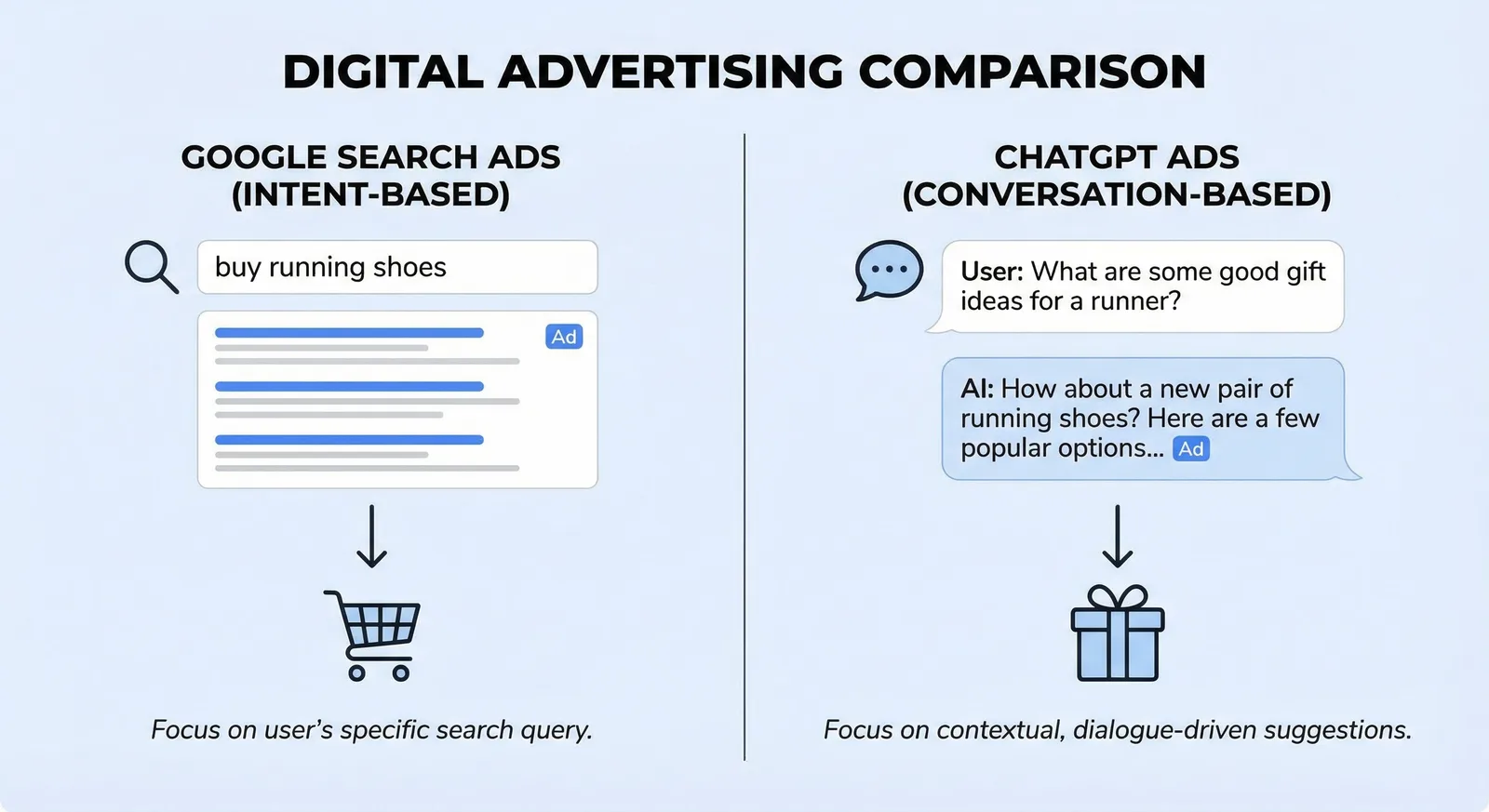
Based on what we know about testing ads in ChatGPT, here is a practical checklist to ensure your business is ready when this goes global.
1. Focus on conversational content
Stop writing only for “keywords.” Start answering the questions your customers actually ask. ChatGPT looks for information that fits naturally into a conversation. If your website has a clear, helpful FAQ section, you are already ahead.
2. Tighten your local SEO
OpenAI’s meal kit example proves that local relevance is key. Make sure your Google Business Profile and local directory listings are 100% accurate. If the AI is looking for a “best café near me” or a “marketing agency in Sevenoaks,” your data needs to be easy for the bots to read.
3. Get your tracking in order
As with any new ad platform, those who have the best data will win. Ensure your Google Analytics 4 (GA4) and conversion tracking are set up properly now. When ads in ChatGPT become available to more businesses, you will need to know exactly which clicks are turning into customers.
4. Build brand authority
The AI is more likely to recommend (or show an ad for) a brand that is cited across the web. Work on getting real customer reviews, appearing in local news, and having a consistent message across all your social channels.
OpenAI is just beginning to explore what conversational advertising looks like, and we are tracking every report and update as they happen. We plan to test these campaigns the moment they are available to ensure our clients have a head start. It is no longer enough to just be on Google: you need to be ready for the way people search in 2026 and beyond.
If you are not sure if your current digital presence is ready for this shift, we can take a look for you. Get in touch for a free marketing audit and we will give you a clear, honest review of your setup. It is a simple way to ensure your business remains visible and easy to choose, no matter how the technology evolves.
Maximus Mediascape | Architects of Digital Excellence
Related guides: Ads in ChatGPT: What This Means for Your Marketing Strategy, ChatGPT Ads Expansion to the UK: What Businesses Need to Know, ChatGPT Ads in India: How Businesses Can Advertise on ChatGPT, ChatGPT Ads for B2B Companies: How to Reach Decision Makers.
OpenAI is currently testing ads in ChatGPT with adult users in the US on the Free and Go tiers. While there is no official date for a global rollout, successful pilots usually expand to other major markets like the UK and UAE within months. We are monitoring OpenAI updates closely and will notify our clients the moment these placements become available locally.
OpenAI has been very clear about answer independence. Ads do not change or influence the organic answers ChatGPT provides. The AI aims to give you the most helpful response possible, and any sponsored content is visually separated and clearly labelled to maintain user trust and transparency.
Google Ads are built around direct search intent, usually when someone is ready to buy. Testing ads in ChatGPT focuses on conversational intent. These ads appear when a user is in the middle of researching a topic or comparing ideas. They feel more like a helpful suggestion within a chat rather than a standalone advertisement.
No. Conversational privacy is a core part of the OpenAI pilot. Advertisers do not have access to your individual chats, memories, or personal details. They only receive aggregate data, such as how many people clicked an ad, ensuring that your personal interactions with the AI remain private.
While the pilot includes major brands through agencies like WPP and Omnicom, the conversational format is ideal for service based industries. We expect to see strong results for restaurants, clinics, real estate, and SaaS companies, as these businesses often thrive on the “recommendation” style of discovery that ChatGPT provides.
Generative Engine Optimisation, or GEO, is the process of making your brand easy for AI models to find and recommend. Just as you optimise for Google, you must now optimise for “Answer Engines” like ChatGPT. Having clear, conversational content and strong brand authority helps the AI decide when your business is the most relevant one to show or suggest.
The best way to prepare is to tighten your digital foundation today. Focus on creating conversational FAQ content on your website, ensuring your Google Business Profile is accurate, and setting up clean conversion tracking. When testing ads in ChatGPT opens to more businesses, those with the best data and clearest messaging will have the biggest advantage.
Want this handled for you every month? See our Care and Growth plans, start with the Starter plan, or see all our services. Curious who we are? Read about us and how we work.
Built to be quoted by AI. This page ships with the same structured data we set up for clients.

Ads in ChatGPT are here. Discover what businesses need to know about OpenAI's advertising rollout and how to adapt your marketing strategy.

ChatGPT Ads in India are now available. Learn how ChatGPT advertising works, how to set up campaigns, costs, targeting and what businesses need to know.

ChatGPT Ads for B2B companies can help brands reach decision makers during early research stages. Learn how they work, benefits, and strategy insights.

Learn how to get your business recommended by ChatGPT using trust signals, reviews, authority content, and AI search visibility strategies.

OpenAI has launched ChatGPT ads in the UK. Discover what the ChatGPT ads expansion UK means for your business and how multi-advertiser placements work.
Understand how people search in ChatGPT compared to Google. Discover the 4 types of AI search behavior and learn how to optimize your brand for AI discoverability.
Type what you want to be found for. We'll come back with a real plan, not a sales pitch.